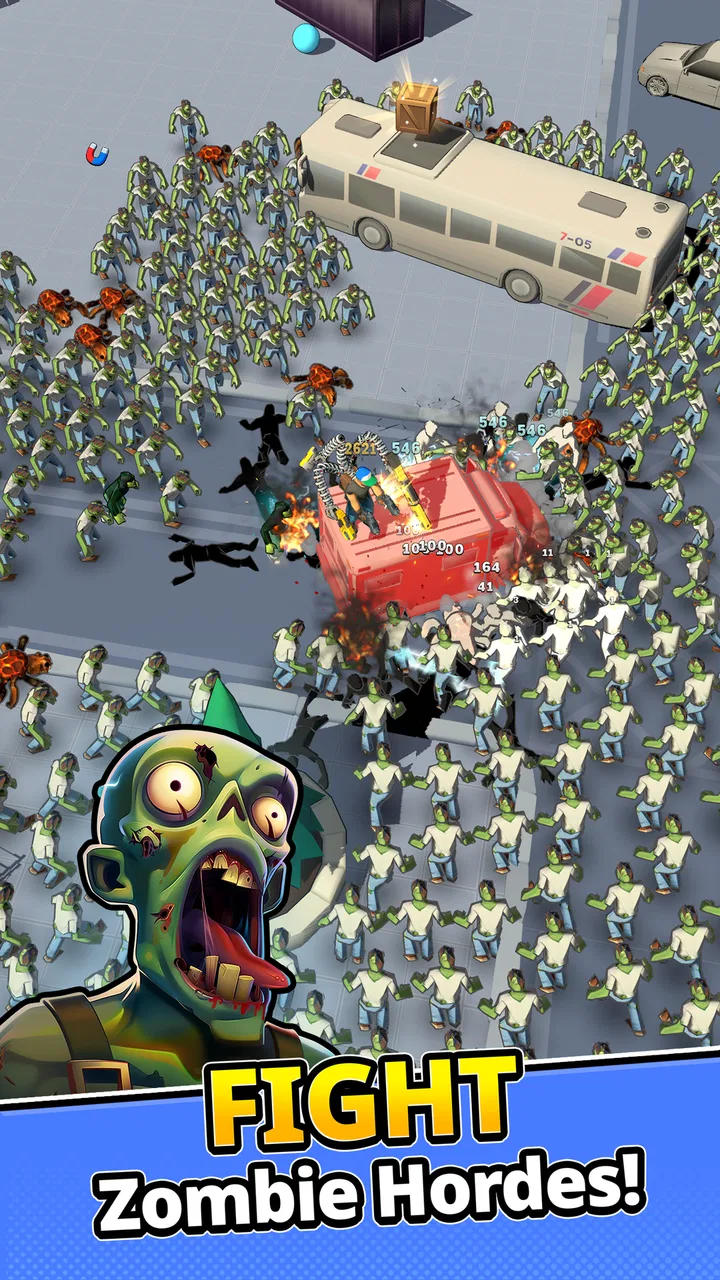
Z Survivor: Backpack Shooter
- 4.4
- Rating
- 1.00M
- Installs
- Free
- Price

 Analysis by App-foxy
I went into Z Survivor: Backpack Shooter expecting a quick action game built around collecting and staying alive, and that is exactly where it makes the most sense. It is a free Android game from Tapped Ltd, aimed at players who enjoy short survival-focused sessions rather than a long story campaign or a carefully staged console-style adventure. The basic appeal is immediate: move through danger, gather what helps, keep your character alive, and make sensible choices before the screen becomes too difficult to control.
That simple loop is also the reason I found it easy to pick up. You do not need a long tutorial period to understand the general goal, and the backpack-shooter idea gives each run a practical decision to make. Every useful item has to fit into a broader plan, so surviving is not only about reacting quickly. It is also about deciding what deserves attention, when to keep moving, and when a tempting pickup is not worth the risk.
How a normal run feels from the first move
The best way to approach the game is to treat each attempt as a short routine rather than an isolated burst of action. I start by checking the immediate space, identifying the safest direction, and only then moving toward nearby rewards. That habit sounds obvious, but it prevents a common mistake in survival games: rushing toward something valuable and ending up surrounded before the character has room to respond.
You May Also Like

 Blood Strike: 2.5 Anniversary
Blood Strike’s Loadouts Turn Every Drop Into a Tactical Gamble
A close look at Blood Strike’s custom loadouts: how fast access to signature weapons reshapes its battle royale rhythm, rewards preparation, and narrows the gap between fights.

 Pandora - Music & Podcasts
Pandora’s Music Is Easy to Start, but Harder to Recover
Pandora’s strength is its low-effort path from a seed to a station. Its weak spot is how much confidence it asks you to place in connection, setup, and quiet recovery.

 8 Ball Pool
 Is Built on Rivalries, Rematches, and Routine
A close look at the rivalries, rematches, shared routines, and unanswered safety questions that turn a quick pool match into a persistent mobile community.

 Samsung Music
’s Quiet Strength Is Playing What You Already Own
Its reach comes less from spectacle than from dependable access to a personal library. That simplicity is both the app’s strongest retention engine and its ceiling.

 AccuWeather: Weather Radar
AccuWeather Review: A Quick, Clear Forecast for Everyday Decisions
For everyday plans, the best forecast is the one you can understand quickly. AccuWeather makes rain timing, radar, and local conditions easy to act on, with a few trade-offs.

 Hill Climb Racing
Why Hill Climb Racing Still Turns Crashes Into One More Run
A tiny car, a bumpy hill and one more upgrade: Hill Climb Racing keeps resurfacing because its simple chaos makes every near-miss feel personal.
More From Our News Desk



The collecting side gives the action a little more shape than a straightforward arena shooter. Instead of simply aiming until everything disappears, I am constantly weighing movement against preparation. A pickup can improve the next part of a run, but reaching it may expose me to threats from another direction. When the screen gets busy, staying alive is usually more useful than chasing one extra item.
I also recommend beginning with a deliberately conservative rhythm. New players often move too aggressively because the game looks simple at first. A slower opening gives you time to understand how danger approaches, how much space you need to turn or retreat, and which situations make the backpack decisions feel difficult. Once that rhythm becomes familiar, you can take more calculated risks without turning every run into a scramble.
A realistic everyday use case is a short break between tasks. I can imagine playing a run while waiting for a meeting, during a commute, or while taking a few minutes away from work. The game does not demand the commitment of a large role-playing title, but it still gives those minutes a purpose. The trade-off is that a run can become absorbing once the pressure rises, so it is worth stopping at a natural point rather than assuming every session will remain casual.
The game is especially comfortable for people who like action with a light layer of planning. If you want a purely reflex-based experience where every second is about aiming, this may feel slower than expected. If you enjoy checking your options, reorganizing your approach, and learning from a failed run, the collecting and survival combination gives you more to think about than the short store summary suggests.
Small settings checks that improve the first session
Before settling into repeated runs, I would spend a moment checking the available control and presentation settings on your device. I do not treat this as busywork. In a game where a late movement decision can end a run, comfortable touch response and clear visibility matter more than flashy presentation. If the controls feel awkward, the problem may be your setup rather than the underlying game.
I prefer a control arrangement that leaves my main movement area unobstructed and keeps my thumb from covering important action. On a smaller phone, this is particularly useful because the screen can become visually crowded when enemies and pickups appear together. On a larger device, I would still avoid placing essential controls too close to the edge, where accidental swipes or a change in grip can interrupt a run.
Sound is another setting worth considering. I usually keep enough audio to recognize the pace of a run, but I lower it when playing in public or while listening to something else. The important point is to decide deliberately. Playing with distractions can make the game feel more chaotic, especially when you are learning which visual cues deserve immediate attention.
The game is available for devices running Android 6.0 or later, so compatibility is broad enough for many older phones. That does not mean every device will feel identical. Screen size, touch sensitivity, battery condition, and background activity can all affect comfort. I would close demanding background apps before a serious session, not because the game requires a complicated setup, but because consistent input is more valuable than squeezing every possible task into the same moment.
It is also useful to remember that this is a free download with optional purchases ranging from $0.99 to $99.99 per item. I would begin by playing without spending and deciding whether the basic loop holds my attention. That approach makes the purchase question much clearer: if the moment-to-moment survival decisions already feel satisfying, optional spending becomes a choice rather than a requirement for finding the fun.
Repeatable habits that make collecting safer
My most useful habit is to separate movement into two purposes: repositioning for safety and collecting for progress. When I combine both too quickly, I tend to enter spaces without a reliable exit. Experienced play is less about grabbing everything and more about creating a route that leaves a fallback direction open.
I also try to avoid making backpack decisions at the most dangerous possible moment. If the game gives you a quiet interval, use it to review what you have and decide what kind of run you are building. Waiting until threats are close makes even a good item feel like a bad choice because the decision is happening under pressure. A calm review is faster in practice than repeatedly improvising while surrounded.
Another useful pattern is to value consistency over spectacular gains. A modest improvement that lets you survive longer is often more useful than a risky pickup that forces you into an unfamiliar position. This is one of the main differences between playing for a memorable run and playing to improve steadily. I would rather finish several controlled attempts than lose each one while chasing the most attractive option on screen.
When I fail, I try to identify the first bad decision rather than blaming the final moment. The end of a run is usually only where the earlier mistake becomes visible. Maybe I entered a narrow area without an escape route, spent too long collecting, or ignored the need to prepare before danger increased. That review turns failure into a practical adjustment instead of a reason to repeat the same pattern.
For players who like a routine, a simple three-step cycle works well: scan the area, choose a safe route, then collect only what fits that route. Afterward, reassess before moving again. This is not a hidden trick or a special feature; it is a way of using the game’s basic systems with more discipline. The benefit is that the action feels less random, especially once the pace starts testing your attention.
Where the action becomes demanding
The game’s accessible opening should not be mistaken for unlimited depth. Its strongest challenge comes from combining quick movement with limited attention. When several threats compete for focus, you may know the correct choice but still make it too late. That makes the experience satisfying for players who enjoy improving through repetition, while potentially frustrating for anyone looking for a relaxed collecting game.
I found that the backpack concept changes how I judge risk. In a standard shooter, the obvious response is often to remove the nearest threat. Here, the better response may be to preserve space, delay a pickup, or choose a less exciting option that supports survival. That extra layer is the game’s clearest personality, but it also means the experience is not as instantly mindless as some casual action titles.
There is a limit to how much variety a compact survival loop can provide. If you need a large narrative, extensive character development, or a broad world to explore, this is probably the wrong choice. A conventional action game may serve you better when you want carefully designed missions and a strong sense of progression outside the next run. Likewise, a slower strategy game is a better fit if you prefer planning without constant physical pressure.
The Teen content rating is worth keeping in mind for families choosing games together. I would not present it as a gentle game for very young children. The action and survival framing are central to its identity, and parents should make their own decision based on the player’s age and tolerance for that style of content.
The current version is 1.00, which makes me approach it as a focused experience rather than assuming a long history of accumulated systems. That is not automatically a weakness. A straightforward game can be easier to understand and easier to recommend, but players who expect years of layered content may find the design more limited than a mature action platform.
Who will enjoy it, and who should skip it
I would recommend this game to someone who wants a free action title that can be understood quickly but rewards better habits over time. It suits players who like compact sessions, collecting under pressure, and the satisfaction of surviving because they made a sensible decision rather than because they simply reacted faster.
It is also a good match for people who enjoy experimenting with their own routines. You can play aggressively, cautiously, or somewhere between the two, then notice which approach produces more reliable results. The game gives enough room for that personal adjustment without requiring a complicated rulebook.
I would be more cautious about recommending it to someone who dislikes repetition. Survival games naturally ask you to replay similar situations, and the enjoyment comes from refining your response. If you want every stage to introduce a completely new idea, the repeated collect-and-survive structure may become familiar too quickly.
Players who dislike optional purchase systems should also decide in advance how they want to handle them. The game costs nothing to start, but the presence of in-app purchases means I would keep spending boundaries clear, especially on a device shared with younger players. Playing first and buying only with a specific reason is the approach I trust most.
Its audience is already substantial: the game has passed one million installs, carries an average rating of 4.3 from around twenty-eight thousand ratings, and has about one and a half thousand written reviews. Those figures do not replace personal experience, but they do suggest that the core idea has reached a meaningful group of players rather than remaining a niche experiment.
My verdict after settling into the loop
What I like most is the way the game turns a familiar survival formula into a sequence of small judgments. The collecting is not interesting merely because items appear; it is interesting because every pickup competes with movement, safety, and attention. That gives the action a practical tension that is easy to understand but not always easy to manage.
My main reservation is that the experience depends heavily on whether you enjoy repeating runs to improve. There is no reason to choose it for a rich story or a huge range of modes. I would also avoid promising that it will suit every phone equally, since touch comfort and screen visibility can change how demanding the action feels. Those are important limitations, not deal-breakers.
For a first session, I suggest checking the controls, playing cautiously, and resisting the urge to collect every tempting reward. Use the opening attempts to learn how much space you need and how quickly a safe route can disappear. Once that foundation is in place, start testing faster paths and more ambitious choices. The improvement feels more satisfying when it comes from a repeatable habit rather than luck.
In the end, Tapped Ltd has made a focused action survival game that works best when you treat it as a compact decision-making challenge. It is free to try, accessible on older Android versions, and simple enough for a quick break, yet it has enough pressure to keep experienced players refining their approach. This is a good pick if you want short, replayable runs where smart movement matters as much as collecting. If you need a story-heavy adventure, deep long-term systems, or a completely relaxed pace, I would choose a different game instead.
FAQs for Z Survivor: Backpack Shooter
01What is the main objective in Z Survivor: Backpack Shooter?
In Z Survivor: Backpack Shooter, the primary objective is to survive waves of zombie attacks while scavenging for resources. Players must strategically use their backpacks to store weapons, ammo, and health supplies. The game combines elements of survival, strategic planning, and fast-paced shooting, making each decision critical for survival.
02How do the backpack mechanics work in the game?
The backpack in Z Survivor: Backpack Shooter serves as a crucial inventory system. Players can equip, swap, and manage various items such as weapons, ammunition, and health kits. The backpack has limited space, requiring players to make strategic choices about which items to carry, thus influencing gameplay and survival chances.
03Is Z Survivor: Backpack Shooter available for both Android and iOS?
Yes, Z Survivor: Backpack Shooter is available for download on both Android and iOS platforms. The game can be found on the Google Play Store for Android users and the Apple App Store for iOS users. Ensure your device meets the necessary system requirements for optimal gameplay experience.
04Does the game support multiplayer mode?
Currently, Z Survivor: Backpack Shooter focuses on single-player gameplay, emphasizing individual strategy and survival skills. The developers have hinted at potential updates, including multiplayer features, to enhance the gaming experience, so it's worth keeping an eye on future updates for new features.
05Are there in-app purchases in Z Survivor: Backpack Shooter?
Z Survivor: Backpack Shooter offers in-app purchases that allow players to buy additional weapons, skins, and other enhancements. While the game is free to download, these purchases can provide advantages and aesthetic upgrades, although they are not necessary to enjoy or complete the game.
Pros
- Engaging survival gameplay elements.
- User-friendly interface and controls.
- Diverse range of weapons.
- Regular updates with new content.
- Offline play mode available.
Cons
- Occasional in-app purchase prompts.
- Some levels are highly repetitive.
- Requires frequent internet connection.
- Limited character customization.
- Battery consumption is quite high.

Z Survivor: Backpack Shooter
Gallery